

Ecoinvent 3: System Models and Market vs. Transformation
Written by Long Trail Sustainability, Senior Consultant, Shelly Severinghaus
Ecoinvent 3 is available in three system models in SimaPro and in market and transformation classifications. Depending on the goal and scope of your study, you may choose to use one system model versus another, and depending on your data availability you may use market or transformation data.
Ecoinvent System Models
Ecoinvent Version 2.2 and earlier were based on the recycled content approach, also known as the cut-off approach, for recycling, which is based on the attributional approach that “inventories the inputs and output flows of all processes of a system as they occur” (JRC 2010). Ecoinvent Version 3 introduced another attributional system model based on the At the Point of Substitution (APOS) approach, AKA Avoided Burden, as well as a consequential system model that “identifies and models all processes in the background system of a system in consequence of a decision made in the foreground system” (JRC 2010). Continue reading for more information about each of the 3 system models.
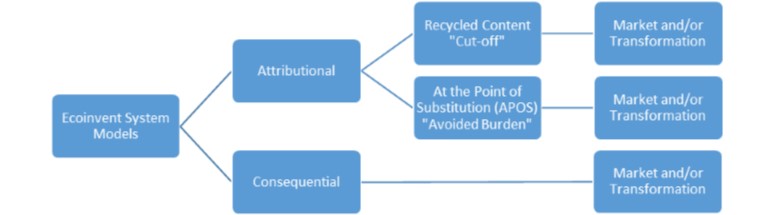
1. Cut-off by Classification (AKA Recycled Content Method)
SimaPro library called Ecoinvent 3 – Allocation, cut-off by classification
The underlying philosophy of this approach is that primary production of materials is always allocated to the first user of a material. If a material is recycled, the primary producer does not receive any credit for providing the recyclable materials. As a consequence, recyclable materials are available burden-free to recycling processes, and secondary – recycled – materials bear only the impacts of the recycling processes.[1]
- Based on the attributional approach
- The recycling process is empty (in SimaPro) for the percent recycled, meaning its burdens are “Cut-Off.” The second life will take the refurbishing burdens.
- This is the same approach to allocation of waste and recyclable by-products as ecoinvent version 2.2 and earlier.
2. At the Point of Substitution (APOS) (AKA the Avoided Burden Method)
SimaPro library called Ecoinvent 3 – At the Point of Substitution
In this approach, a recycling credit is given to the recycler for their efforts to keep materials out of the waste stream, equal to the amount of virgin material that the next person doesn’t need to use, less the amount of environmental burdens it takes to refurbish the material.[2]
- Based on the attributional approach
- The recycling process avoids virgin material process for the percent recycled (i.e. its burdens are “Avoided” and pushed to the second life) and includes refurbishing (practitioner must add to SimaPro recycling process).
We offer a 3-hour online training class dedicated to recycling if you’re interested in learning more!
3. Consequential
SimaPro library called Ecoinvent 3 – consequential
The consequential system model uses different basic assumptions to assess the consequences of a change in an existing system.[3]
- Based on the consequential approach
- “Substitution, consequential, long-term”
More information about the system models is available on the ecoinvent webpage >> http://www.ecoinvent.org/database/ecoinvent-version-3/system-models-in-ecoinvent-3/system-models-in-ecoinvent-3.html and in this PRe article >> https://www.pre-sustainability.com/ecoinvent-different-system-models
Market vs. Transformation
In addition to the three system models, ecoinvent version 3 classifies data into Market and Transformation, something that had not been done in previous versions.
Market
A market activity is an activity that does not transform inputs, but simply transfers the intermediate exchange from one transforming activity to another transforming activities that consumes this intermediate exchange as an input, e.g. from glycerine at the supplier to glycerine at the consumer.[4]
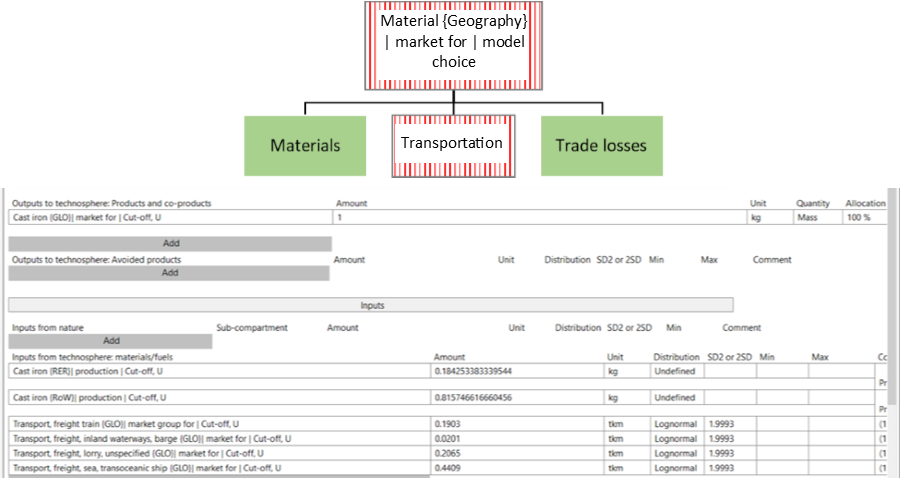
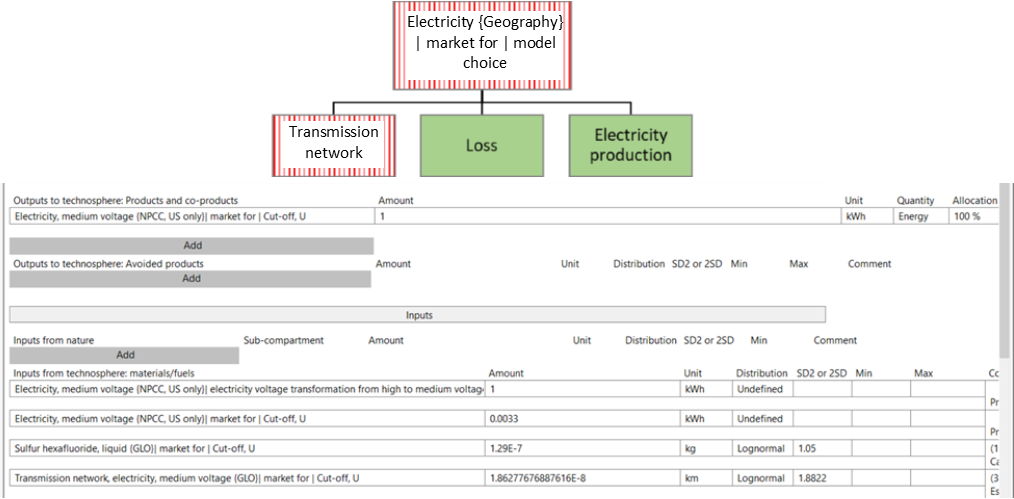
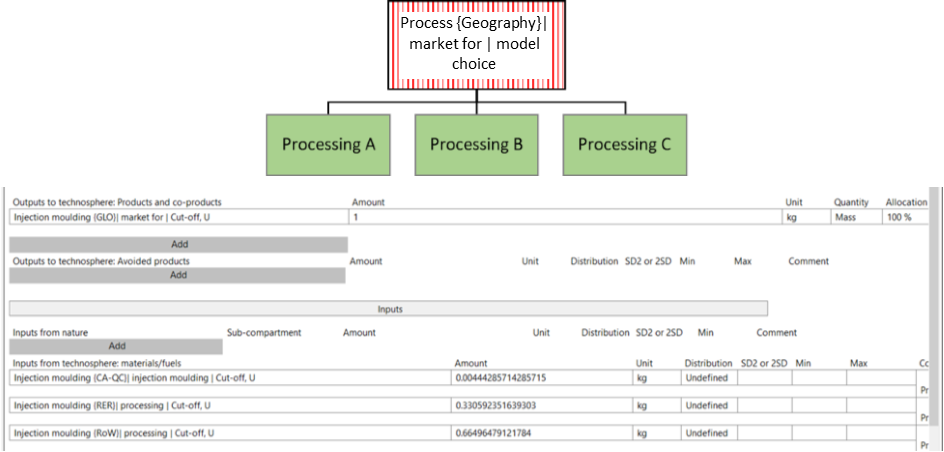
The Market processes include the product, transportation to the next user (an average global transport model is applied) and any transport or trade losses. Market processes are indicated with red and white stripes in network analyses in SimaPro.
- Material market processes typically include:
- Global transportation model
- Any trade losses
- Product itself (mix of country/regional transformation processes)
- Electricity market processes typically include:
- Transmission network (e.g. powerlines)
- Loss
- Electricity production (includes voltage level and creation source (e.g. hydro))
- Processing market processes typically include:
- Mix of transformation processes
Transformation
A human activity that transforms inputs into outputs that are different from the inputs. This is the most common type of activity in the ecoinvent database, e.g. a hard coal mine that transforms hard coal in ground to the marketable product hard coal, or an automobile plant that turns metals, plastics and energy into cars. [5]
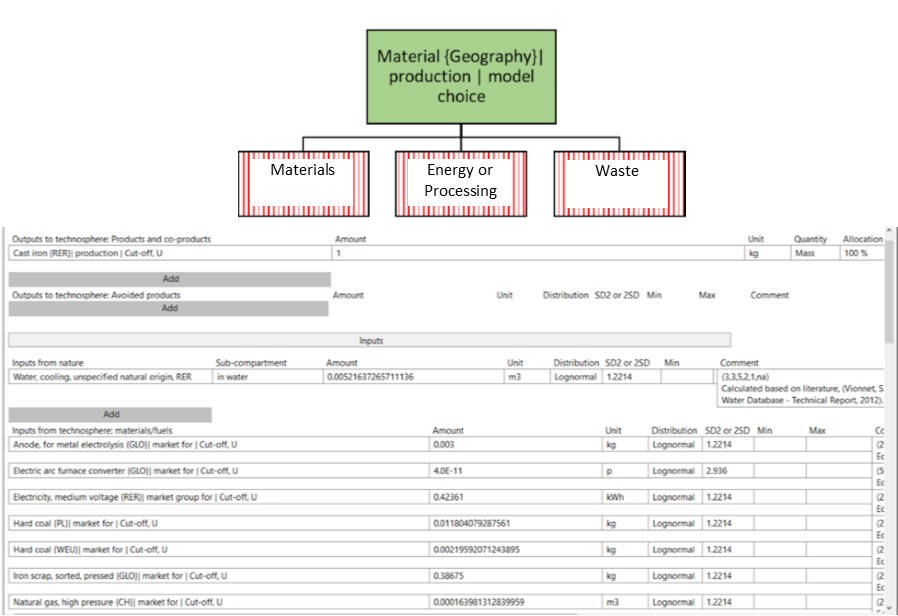
The Transformation processes are the product itself, or the activity.
- Material transformation processes typically
include:
- Inputs to make product
- Energy and/or processing to make product
- Waste to make product
Notice that even though this is a transformation material, the underlying inputs and outputs are usually market materials because they are market averages.
- Electricity transformation processes typically
include:
- Material inputs
- Direct emissions

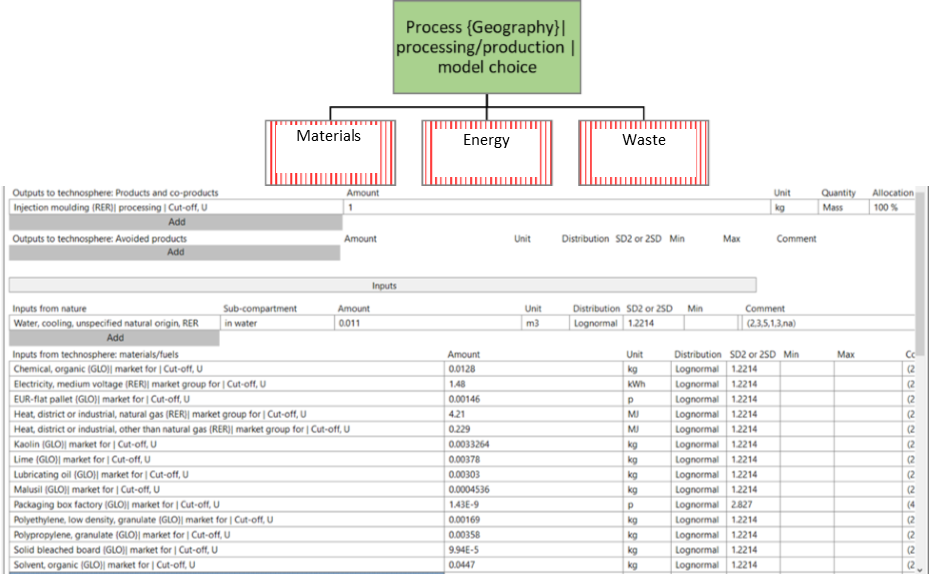
- Processing transformation processes typically
include:
- Material inputs to perform process
- Energy to perform process
- Waste to perform process
Learn more here >> http://www.ecoinvent.org/support/faqs/methodology-of-ecoinvent-3/what-is-a-market-and-how-is-it-created.html
Long Trail Sustainability offers 1-on-1 training, providing
expert guidance and answers to your LCA and SimaPro questions and has the
world’s largest LCA training program. More information here >> https://longtrailsustainability.com/services/sustainability-training/
[1] http://www.ecoinvent.org/database/ecoinvent-version-3/system-models-in-ecoinvent-3/system-models-in-ecoinvent-3.html
[2] Ibid.
[3] Ibid.
[4] http://www.ecoinvent.org/support/glossary/glossary-detail.html
[5] Ibid.